Home services marketplace SEO case study
Helpling: turning cleaning-service searches into commercial page growth.
A cleaning services SEO case study for marketing leaders who need technical SEO, service-page optimisation, authority, and measurement to work as one programme.
Discuss a similar problem
What did the SEO programme change for Helpling Singapore?
Helpling needed to compete for high-intent cleaning searches in Singapore. The work concentrated on the pages most closely connected to bookings, then supported those pages with technical improvements, clearer intent matching, structured data, internal links, and steady authority building.
estimated monthly organic visits
Ahrefs estimate across 257 ranking pages in the supplied case-study snapshot.
visits from ten cleaning pages
The commercial cleaning cluster represented 52% of the estimated organic traffic in the snapshot.
positions for high-intent terms
Included move-out cleaning, part-time cleaner, cleaning services Singapore, and sofa cleaning Singapore.
estimated monthly traffic value
An Ahrefs paid-search-equivalent estimate, not booked revenue.
How the website is being discovered across AI search today.
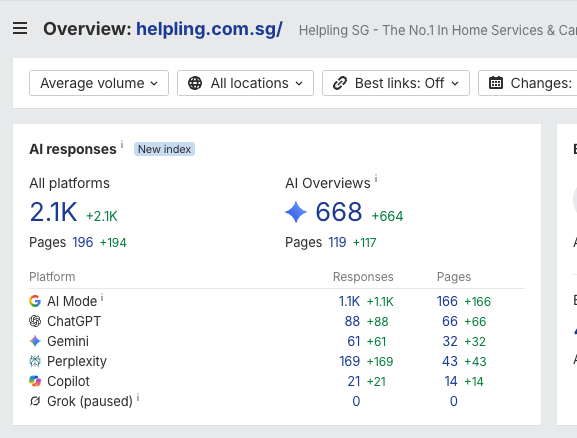
See where Helpling Singapore is being found across Google AI Mode, AI Overviews, ChatGPT, Gemini, Perplexity, and Copilot. The platform counts are shown alongside the original screenshot so a marketing leader can understand the result without decoding an SEO report.
Helpling Singapore
Helpling’s service and advice pages appear across the major AI answer platforms, giving customers multiple routes into the brand beyond a conventional ranking.
- AI responses
- 2.1K+2.1K
- Pages appearing in AI responses
- 196+194
- Google AI Overviews
- 668+664
Swipe or scroll to inspect the original screenshot. Tap it to open the full-size image.
The business, market, and work at a glance.
See whether the website, market, and responsibilities are close to the growth problem your team is trying to solve.
- Website type
- Home-services marketplace
- Markets represented
- Singapore
- Website and tools
- Google Search Console, Ahrefs
- What we owned
- SEO leadership and implementation for commercial service pages
What this work shows we can help your team solve.
Use these topics to judge whether our experience is close to your website, business model, and growth problem.
Industry and website
- Home services marketplace
- Home-services marketplace
- Marketplace SEO
SEO work
- Local SEO
- On-page SEO
- Technical SEO
Growth problems
- Commercial page growth
- Local service discovery
The website had to win searches close to a booking decision.
A marketplace can attract broad informational traffic and still miss the searches that matter commercially. Helpling needed its core and specialist cleaning pages to become the most relevant destination for people already looking for a provider.
The practical challenge was bigger than rewriting one landing page. Indexation, crawl efficiency, internal linking, page templates, structured data, supporting links, and the relationship between the main cleaning page and each sub-service had to reinforce the same commercial architecture.
For a local services business, the useful keywords are the ones that reveal a booking need. The SEO plan separated broad cleaning keywords from local service combinations, then checked how the top pages appeared in Google search. That made the keyword work practical: each local page had a clear business purpose, the content answered the immediate service question, and Google could follow the relationship between the main service and its specialist options.
The work was designed as one connected system.
Fix technical access
Improved indexing and crawl efficiency, reduced template-level ambiguity, and strengthened internal paths into priority service pages.
Match service intent
Reworked page copy, titles, headings, and FAQs around deep cleaning, move-out cleaning, post-renovation cleaning, part-time cleaners, and specialist services.
Clarify the service entities
Used service and FAQ structured data available at the time to make page purpose and service relationships easier for search engines to interpret.
Support the money pages
Built relevant links at a measured pace and directed internal authority toward the pages responsible for qualified demand.
The strongest pages became visible for the searches most closely tied to revenue.
The supplied Ahrefs snapshot attributes 22.1K monthly visits to ten cleaning-intent pages, led by the main cleaning-services page. The cluster held first- or second-position rankings for several high-commercial-intent terms.
The client-approved testimonial adds the operating result: agreed KPIs were reached in less than three months, and key revenue-driving pages moved from positions six or seven to positions one and two.
This was not an increase built from one keyword or one page. Organic growth came from improving the whole local cluster, so that more organic traffic could reach the right cleaning service. The reporting kept commercial pages visible as a group and used Google performance alongside third-party estimates. That distinction helped the marketing team see whether the SEO work was increasing useful demand for the business, not merely adding visits.
“We hit our KPIs in less than three months. We moved our key revenue-driving pages to positions one and two, where we were previously ranking at six or seven.”
James Lim, CEO, Helpling APAC
What another team can take from this work.
Organise around services, not keyword volume
The page architecture should reflect how customers choose and book the service.
Make the commercial cluster measurable
Report the priority service pages separately from broad blog traffic.
Treat implementation as part of strategy
Technical, content, internal-link, and authority work created the outcome together.
Review the local search journey
A customer may begin with broad keywords, compare the top providers, and then narrow the search to a specific cleaning need. The page system should support that entire decision.
Continue from this proof to the work it demonstrates.
Evidence is more useful when its boundary is explicit.
- Ahrefs traffic and traffic value are estimates, not first-party revenue.
- The historical snapshot is not presented as current performance.
Have a comparable search problem?
Tell us the website, market, commercial goal, current evidence, and what your team can implement. We will recommend the right starting point.
Book a meeting