Online travel marketplace SEO case study
CuddlyNest SEO: growth across 1.2 million travel pages.
A travel SEO case study about managing technical access, search-led inventory, internal linking, and content growth across a large online travel agency.
Discuss a similar problem
See the result before reading how the work was done.
These are the original Search Console, Analytics, or Ahrefs screenshots used for this case study. Open any image to inspect it at full size.
Clicks rose from 2.91K to 19K and average position improved from 41.1 to 35.9.
The later period produced more than four times the clicks and more than three times the impressions.
The growth in total ranking keywords and the separate top-three and top-ten segments.
What did the SEO programme change for CuddlyNest?
CuddlyNest had more than one million indexable travel pages and little established SEO infrastructure. Growth depended on making the inventory easier to crawl, deciding which pages deserved to exist, and building content and internal-linking systems that could scale across hotels, vacation rentals, and destinations.
year-on-year organic clicks
Later comparison month versus the corresponding baseline month in the supplied Search Console report.
clicks in the later eight-month period
Compared with 17.9K clicks in the baseline period shown in Search Console.
impressions in the later period
Compared with 3.5M impressions in the earlier period.
ranking keywords
Historical Ahrefs snapshot supplied in the source deck.
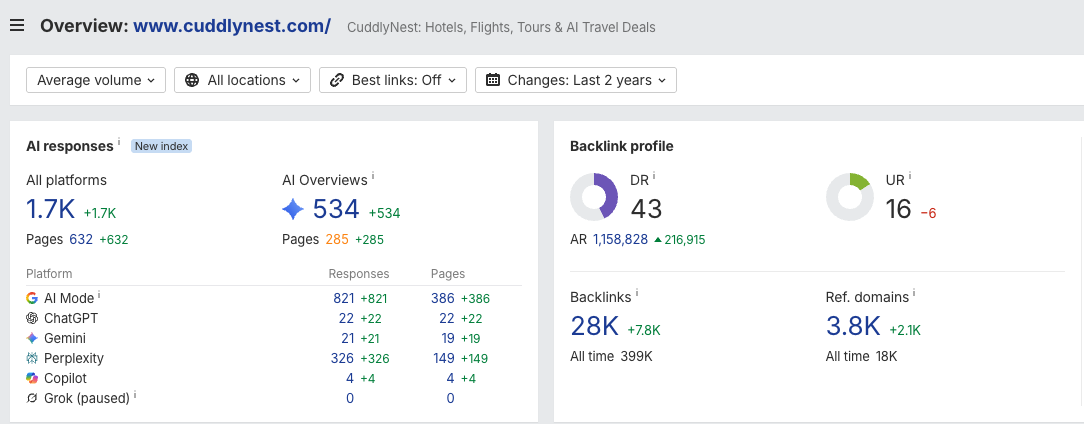
How the website is being discovered across AI search today.
See where CuddlyNest is being found across Google AI Mode, AI Overviews, ChatGPT, Gemini, Perplexity, and Copilot. The platform counts are shown alongside the original screenshot so a marketing leader can understand the result without decoding an SEO report.
CuddlyNest
Travel inventory and destination content now appear across thousands of AI responses, with Google AI Mode and Perplexity showing the widest visibility in this capture.
- AI responses
- 1.7K+1.7K
- Pages appearing in AI responses
- 632+632
- Google AI Overviews
- 534+534
Swipe or scroll to inspect the original screenshot. Tap it to open the full-size image.
The business, market, and work at a glance.
See whether the website, market, and responsibilities are close to the growth problem your team is trying to solve.
- Website type
- Online travel marketplace
- Markets represented
- International
- Website and tools
- Google Search Console, Ahrefs
- What we owned
- Technical SEO, programmatic page strategy, content systems, and international search
What this work shows we can help your team solve.
Use these topics to judge whether our experience is close to your website, business model, and growth problem.
Industry and website
- Online travel marketplace
- Travel SEO
SEO work
- Travel SEO
- Marketplace SEO
- International SEO
Growth problems
- International growth
- Marketplace architecture
Scale made every SEO decision more expensive.
With approximately 1.2 million pages, a weak template, crawl rule, or internal-link decision could affect thousands of URLs. Publishing more pages was not automatically progress; the inventory had to reflect actual combinations of destination demand and available supply.
The travel marketplace also needed distinct strategies for hotels, vacation rentals, destinations, and editorial content. Those page types serve different search intents and cannot be managed as one undifferentiated content library.
The work was designed as one connected system.
Control the indexable inventory
Used demand and supply criteria to decide which scalable landing pages deserved discovery and indexation.
Repair technical foundations
Reviewed crawl access, templates, duplication, page quality, and the pathways search engines used to reach a very large inventory.
Build travel topic systems
Expanded destination and travel content around researched demand, then connected it to relevant marketplace pages.
Automate useful internal links
Designed rules and tools that prioritised links by page value instead of adding uniform links across every template.
Organic visibility expanded across commercial inventory and editorial content.
The historical Search Console evidence records 76.1K clicks and 12.3M impressions in the later comparison period, versus 17.9K clicks and 3.5M impressions in the baseline period. A separate matched-month comparison shows clicks increasing from 2.91K to 19K year on year.
The supplied Ahrefs chart shows 48,176 ranking keywords in the recorded snapshot. The important operating change was the system behind the numbers: inventory rules, automated internal links, structured research, and a content engine that could support marketplace pages.
Over the measured months, the website developed a larger organic traffic footprint without treating every available listing as equally valuable. That increase took time because travel services, destinations, and accommodation inventory had to work as one useful website rather than a collection of disconnected URLs. The traffic figures are historical, but the operating lesson remains relevant for large marketplaces.
What another team can take from this work.
Inventory is an SEO product decision
Programmatic pages should exist because demand and supply create a useful destination, not because a template can generate them.
Internal linking needs priorities
A large marketplace needs rules that direct crawling and authority toward commercially meaningful pages.
Separate systems from one-off content
The biggest gains came from repeatable research, page, and linking systems rather than isolated blog posts.
Continue from this proof to the work it demonstrates.
Evidence is more useful when its boundary is explicit.
- Third-party keyword estimates are directional.
- The case does not claim that every indexable page contributed equally.
Have a comparable search problem?
Tell us the website, market, commercial goal, current evidence, and what your team can implement. We will recommend the right starting point.
Book a meeting