Philippine automotive publishing SEO case study
Expressway.ph: growing from 56,076 to 154,262 organic clicks in three months.
A Philippine automotive SEO case study about building a useful motorist resource from verified toll data, route information, RFID guidance, and scalable search pages.
Discuss a similar problemSee the result before reading how the work was done.
These are the original Search Console, Analytics, or Ahrefs screenshots used for this case study. Open any image to inspect it at full size.

Clicks increased by approximately 175%, while average position improved from 7.5 to 7.0.
What did the SEO programme change for Expressway.ph?
Expressway.ph was built as a search-first information product for Filipino motorists. The programme combined structured toll data, route and RFID content, technical crawl controls, internal links, and page templates that could answer practical driving questions at scale.
clicks in the later three months
Compared with 56,076 clicks in the preceding three-month Search Console period.
organic click growth
Calculated from the two Search Console periods shown in the archived evidence.
impressions in the later period
Compared with 4.45M impressions in the preceding three months.
average position
The later-period account average shown in Search Console, compared with 7.5 previously.
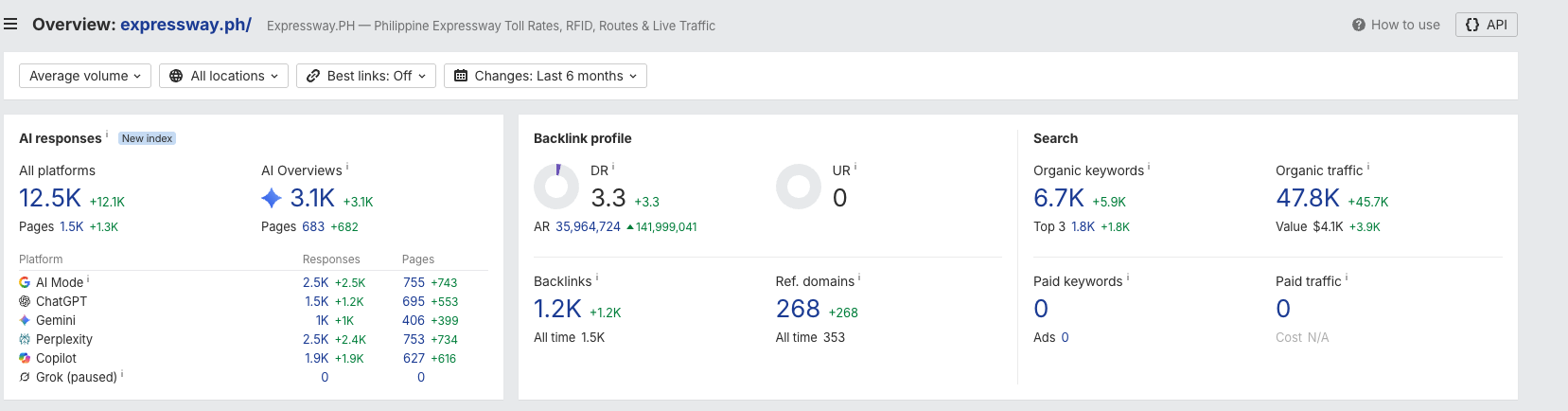
How the website is being discovered across AI search today.
See where Expressway.ph is being found across Google AI Mode, AI Overviews, ChatGPT, Gemini, Perplexity, and Copilot. The platform counts are shown alongside the original screenshot so a marketing leader can understand the result without decoding an SEO report.
Expressway.ph
A search-first Philippine utility now appears across Google AI Mode, AI Overviews, ChatGPT, Gemini, Perplexity, and Copilot while its organic search footprint has also expanded.
- AI responses
- 12.5K+12.1K
- Pages appearing in AI responses
- 1.5K+1.3K
- Google AI Overviews
- 3.1K+3.1K
- Estimated organic traffic
- 47.8K+45.7K
Swipe or scroll to inspect the original screenshot. Tap it to open the full-size image.
The business, market, and work at a glance.
See whether the website, market, and responsibilities are close to the growth problem your team is trying to solve.
- Website type
- Search-first data and publishing platform
- Markets represented
- Philippines
- Website and tools
- Next.js, Supabase, Google Search Console
- What we owned
- SEO product strategy, technical SEO, programmatic content, structured data, and editorial systems
What this work shows we can help your team solve.
Use these topics to judge whether our experience is close to your website, business model, and growth problem.
Industry and website
- Philippine automotive publishing
- Search-first data and publishing platform
- Marketplace SEO
SEO work
- Technical SEO
- SEO analytics and reporting
- Content strategy
Growth problems
- Organic traffic growth
- Data publishing
Philippine motorists needed accurate answers spread across fragmented sources.
Toll rates, RFID systems, route choices, expressway rules, and vehicle information often sit on different websites or inside hard-to-use documents. Expressway.ph needed to turn that fragmented information into pages a driver could understand quickly.
The SEO challenge was also a product challenge. Thousands of rate combinations and route questions could not be managed as isolated articles. The site needed a structured data model, dependable templates, clear crawl paths, and editorial pages that explained the data rather than merely repeating it.
The work was designed as one connected system.
Build around verified motorist data
Organised toll-rate, route, RFID, road-rule, and vehicle information into distinct page types with a clear user purpose.
Control scalable page creation
Used demand, available data, page usefulness, and indexation rules to decide which routes and supporting pages should exist.
Strengthen technical discovery
Reviewed crawl coverage, canonical signals, sitemaps, structured data, template quality, and internal links across the growing site.
Connect tools with explanations
Linked calculator and reference experiences to guides that explain fees, RFID choices, routes, and the decisions a Filipino driver is trying to make.
Search Console recorded 154,262 clicks in the later three-month period.
The archived comparison shows clicks increasing from 56,076 to 154,262 and impressions increasing from 4.45 million to 12.3 million. Average position improved from 7.5 to 7.0 while the account-level click-through rate remained 1.3%.
The chart demonstrates search growth across the property; it does not assign the increase to one template, article, or technical change. The practical result is that a structured Philippine information product reached substantially more motorists while maintaining page-one average visibility at account level.
What another team can take from this work.
Treat data as a product
Verified rates become more useful when page templates, explanations, sources, and update processes are designed together.
Let user decisions shape the architecture
Drivers search by road, RFID system, entry and exit point, vehicle class, fee, and route. Those relationships should be explicit in the site.
Separate account growth from page causality
Search Console proves property-level change. Page-level conclusions require the matching landing-page and query data.
Continue from this proof to the work it demonstrates.
Evidence is more useful when its boundary is explicit.
- The comparison is property-wide and does not isolate one page type.
- Clicks and impressions are not presented as leads or revenue.
Have a comparable search problem?
Tell us the website, market, commercial goal, current evidence, and what your team can implement. We will recommend the right starting point.
Book a meeting