Niche ecommerce and children’s publishing SEO case study
Tapaswe: growing from 65 to 2,794 organic clicks in three months.
A niche ecommerce SEO case study about matching product pages and educational content to how families search for illustrated cultural-learning books.
Discuss a similar problemSee the result before reading how the work was done.
These are the original Search Console, Analytics, or Ahrefs screenshots used for this case study. Open any image to inspect it at full size.

Clicks increased more than forty-fold while average position improved from 8.5 to 7.1.
What did the SEO programme change for Tapaswe?
Tapaswe serves a specialised audience looking for illustrated learning books for children. The programme connected product-page intent, language and cultural accuracy, technical store foundations, images, and supporting educational content.
clicks in the later three months
Compared with 65 clicks in the preceding Search Console period.
increase in organic clicks
Rounded comparison of the two periods shown in Search Console.
impressions in the later period
Compared with 13,800 impressions previously.
average position
Compared with 8.5 in the preceding period.
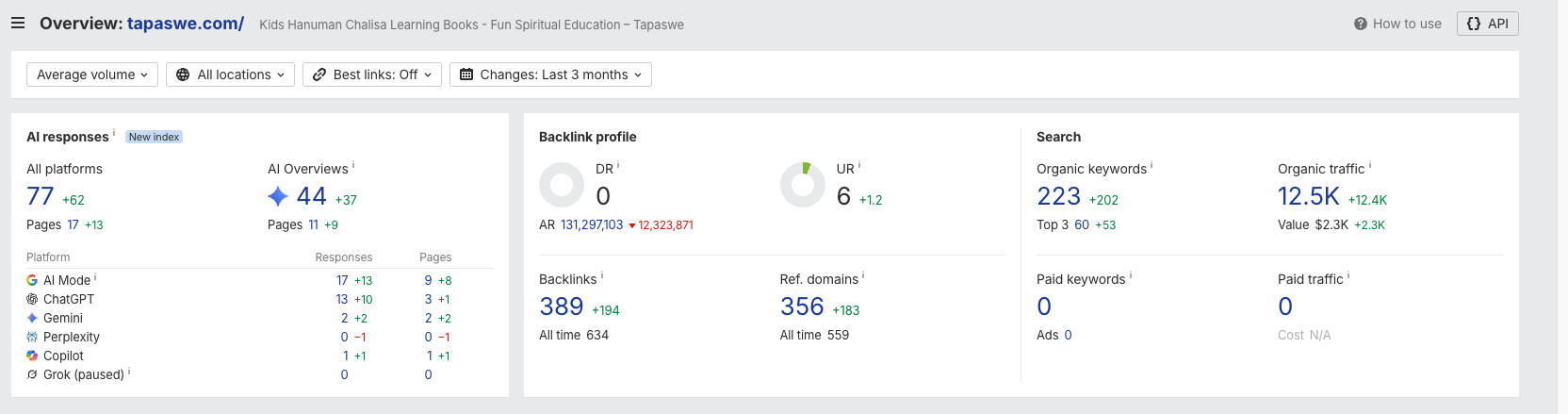
How the website is being discovered across AI search today.
See where Tapaswe is being found across Google AI Mode, AI Overviews, ChatGPT, Gemini, Perplexity, and Copilot. The platform counts are shown alongside the original screenshot so a marketing leader can understand the result without decoding an SEO report.
Tapaswe
Specialist educational publishing has created both conventional search demand and a growing footprint in AI answers from a compact collection of pages.
- AI responses
- 77+62
- Pages appearing in AI responses
- 17+13
- Google AI Overviews
- 44+37
- Estimated organic traffic
- 12.5K+12.4K
Swipe or scroll to inspect the original screenshot. Tap it to open the full-size image.
The business, market, and work at a glance.
See whether the website, market, and responsibilities are close to the growth problem your team is trying to solve.
- Website type
- Shopify ecommerce and publishing website
- Markets represented
- India, International English-speaking markets
- Website and tools
- Shopify, Google Search Console
- What we owned
- Shopify SEO, product-page optimisation, cultural-topic research, technical SEO, and content planning
What this work shows we can help your team solve.
Use these topics to judge whether our experience is close to your website, business model, and growth problem.
Industry and website
- Niche ecommerce and children’s publishing
- Shopify ecommerce and publishing website
- Ecommerce SEO
SEO work
- Ecommerce SEO
- Shopify SEO
- SEO content strategy
Growth problems
- Shopify growth
- Product discovery
A specialised product needed to compete with marketplaces and established publishers.
Parents may search by book, language, age, learning outcome, prayer, illustration, pronunciation, or cultural topic. A small store needs to answer those different attributes without creating overlapping product and article pages.
The subject also requires accurate names, respectful language, useful images, and product information that helps a parent evaluate suitability—not generic ecommerce copy inserted around keywords.
The work was designed as one connected system.
Clarify product-page intent
Aligned product titles, headings, descriptions, images, language attributes, and age relevance with the way families evaluate the books.
Protect cultural accuracy
Used terminology and editorial checks appropriate to the subject instead of treating spiritual and language concepts as interchangeable keywords.
Support products with useful content
Planned educational pages that answer learning and cultural questions while linking naturally to the relevant books.
Improve Shopify discovery
Reviewed technical indexation, collections, metadata, internal links, image signals, and structured product information.
The later period recorded 2,794 clicks and 169,446 impressions.
Search Console shows 2,794 clicks in the later three months compared with 65 previously. Impressions increased from 13,800 to 169,446, and average position improved from 8.5 to 7.1.
The chart records property-level visibility and clicks. It does not disclose orders, conversion rate, or revenue, so the public conclusion remains limited to organic-search growth.
What another team can take from this work.
Treat product attributes as search entities
Language, age range, format, subject, learning support, and cultural context help users and search systems understand the product.
Use editorial care as differentiation
Accurate, respectful explanations create more trust than high-volume generic content in a specialist category.
Link education to the correct product
Supporting content should resolve a real question and lead to the book that matches it, not send every article to the store homepage.
Continue from this proof to the work it demonstrates.
Evidence is more useful when its boundary is explicit.
- Search growth is not presented as order or revenue growth.
- The public chart is property-wide rather than product-specific.
Have a comparable search problem?
Tell us the website, market, commercial goal, current evidence, and what your team can implement. We will recommend the right starting point.
Book a meeting