BPO and outsourcing services SEO case study
Acelerar: finding which BPO searches produced real buyer enquiries—and where attribution broke.
A BPO SEO case study about connecting service and comparison content to genuine outsourcing demand, lead quality, and AI-search referrals.
Discuss a similar problem
What did the SEO programme change for Acelerar Technologies?
Acelerar already had organic visibility and enquiries. The more valuable question was which pages and channels produced real buyers, which submissions were noise, and what the website needed to measure before scaling.
submissions reviewed
Validated lead-store records from 21 January to 15 June 2026.
estimated real buyer leads per month
Manual quality review separated buying intent from spam, pitches, job seekers, and tests.
identifiable AI-referrer share
ChatGPT, Gemini, and Brave referrals among identifiable lead sources.
ranking for the winning comparison page
Ahrefs position for a 600-volume data-entry outsourcing term at the review date.
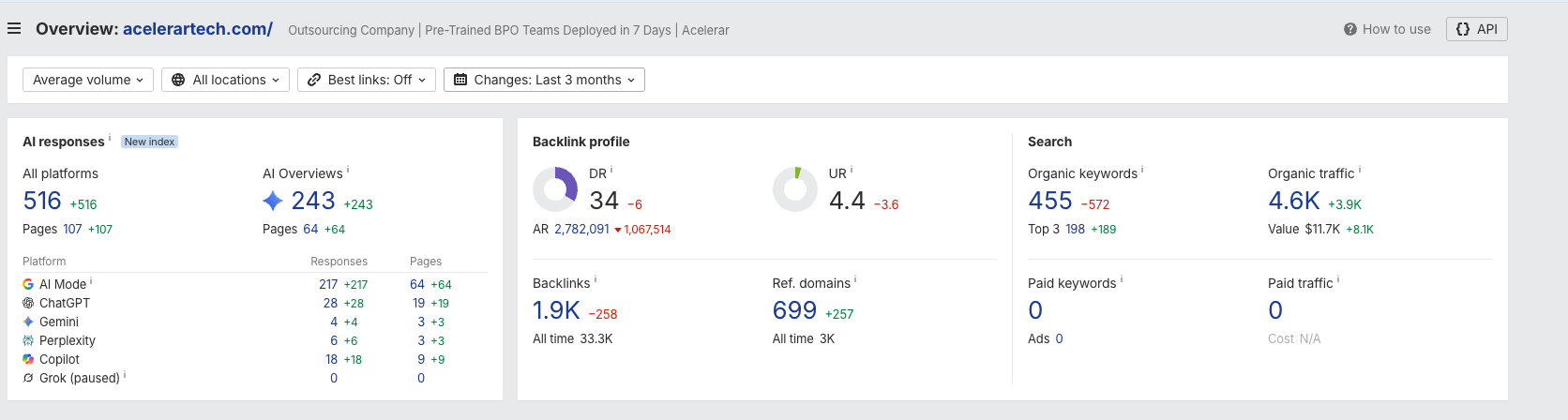
How the website is being discovered across AI search today.
See where Acelerar Technologies is being found across Google AI Mode, AI Overviews, ChatGPT, Gemini, Perplexity, and Copilot. The platform counts are shown alongside the original screenshot so a marketing leader can understand the result without decoding an SEO report.
Acelerar Technologies
Commercial outsourcing content is being surfaced across Google AI experiences and answer engines while estimated organic traffic and top-three keyword coverage have grown.
- AI responses
- 516+516
- Pages appearing in AI responses
- 107+107
- Google AI Overviews
- 243+243
- Estimated organic traffic
- 4.6K+3.9K
Swipe or scroll to inspect the original screenshot. Tap it to open the full-size image.
The business, market, and work at a glance.
See whether the website, market, and responsibilities are close to the growth problem your team is trying to solve.
- Website type
- BPO and outsourcing services website
- Markets represented
- United States, International
- Website and tools
- Supabase lead store, Ahrefs, Google Search Console
- What we owned
- BPO content architecture, lead attribution analysis, SEO, and AI-search measurement
What this work shows we can help your team solve.
Use these topics to judge whether our experience is close to your website, business model, and growth problem.
Industry and website
- BPO and outsourcing services
- BPO and outsourcing services website
- B2B SEO
SEO work
- BPO SEO
- Lead generation SEO
- SEO analytics
- GEO agency
Growth problems
- Lead attribution
- BPO buyer demand
Form volume looked healthy, but the site could not reliably show which search journey created a customer.
Most submissions landed in the database with the contact page as their source. That erased the service page, comparison, or article that had actually introduced the buyer.
Lead status was also not being advanced from new to qualified, won, or lost. Without that feedback loop, the business could count forms but could not calculate qualified leads, customers, or revenue by landing page.
The work was designed as one connected system.
Read the lead store
Reviewed 95 submissions, messages, referrers, UTMs, source pages, and status fields instead of treating every form as equal demand.
Separate buyers from noise
Classified real outsourcing enquiries apart from outbound pitches, job seekers, bots, and internal tests.
Identify proven page shapes
Connected lead evidence with organic pages and found that bottom-funnel comparison and specialist service pages produced visible buying intent.
Design the measurement fix
Specified first-touch landing-page capture, lead-status stages, page-level forms, and qualification controls needed for closed-loop reporting.
What was found, what changed, and how the evidence supports it.
This table keeps the business problem, SEO response, and supporting proof together so the result can be evaluated without guesswork.
| Problem found | What changed | Supporting evidence |
|---|---|---|
| The contact page overwrote the original landing page | Defined first-touch and entry-page attribution for every enquiry | 83% of captured leads showed the form or homepage rather than the page that created demand |
| Every submission remained marked new | Specified qualified, won, and lost lifecycle stages with conversion dates | 95 of 95 records were new and none had a conversion timestamp |
| Submission count included low-quality noise | Reviewed messages and defined spam and qualification controls | Manual review estimated roughly 10–12 genuine buyer leads per month |
| Content expansion lacked a buyer signal | Prioritised page types and services already visible in real enquiries | The leading comparison page ranked #2 and had directly attributed leads |
The audit replaced a form-count story with a clearer view of buyer demand and measurement gaps.
The validated store contained 95 submissions. Manual review estimated about 40% as genuine buying enquiries, with ecommerce operations, data services, real-estate support, bookkeeping, insurance back office, and staff augmentation among the recurring needs.
AI referrals were small but unusually qualified: approximately six of seven reviewed AI-referrer enquiries appeared to be real buyers. The leading bottom-funnel comparison page also ranked second for a 600-volume term and carried direct lead evidence.
This is a lead-quality and attribution case, not a claim that SEO generated 95 qualified leads. The work established what could be trusted, what could not, and how to close the gap.
What another team can take from this work.
A form submission is not automatically a lead
Quality review and lifecycle status are necessary before a marketing team reports demand generation.
Preserve the first page
A contact form should carry the original landing page and referrer so the content that created the opportunity remains visible.
Let buyer messages shape the roadmap
Repeated service requests are stronger expansion signals than a content calendar built only from volume.
Continue from this proof to the work it demonstrates.
Evidence is more useful when its boundary is explicit.
- The 95 records include spam, pitches, job seekers, bots, tests, and genuine buyers.
- Incomplete lifecycle and first-touch fields prevent a verified customer or revenue attribution claim.
- The AI-referrer share is based on identifiable sources, not all visits.
Have a comparable search problem?
Tell us the website, market, commercial goal, current evidence, and what your team can implement. We will recommend the right starting point.
Book a meeting