Modular buildings and portable storage SEO case study
Mobile Modular: validating enterprise SEO priorities across millions of impressions and a complex product network.
An enterprise SEO case study about turning Search Console, analytics, technical findings, products, locations, and business data into a defensible implementation plan.
Discuss a similar problem
What did the SEO programme change for Mobile Modular?
Mobile Modular operates a large multi-location website across modular offices, classrooms, buildings, restrooms, and related solutions. The work began by validating the underlying search and analytics data so technical and content priorities could be tied to real product and market demand.
validated Search Console impressions
Aggregate across the top 1,000 page rows in the audited export.
validated Search Console clicks
Aggregate across the same top-page export.
validated analytics sessions
Positive session total in the audited analytics file.
documented findings
Including seven critical findings; 34 automated validation checks passed and none failed.
Two distinct brands, each with its own AI-search footprint.
Mobile Modular and Mobile Modular Portable Storage serve related customers, but they are separate websites with different products, page systems, and search results. Each snapshot is presented independently so buyers can see the breadth of the enterprise work without combining the brands.
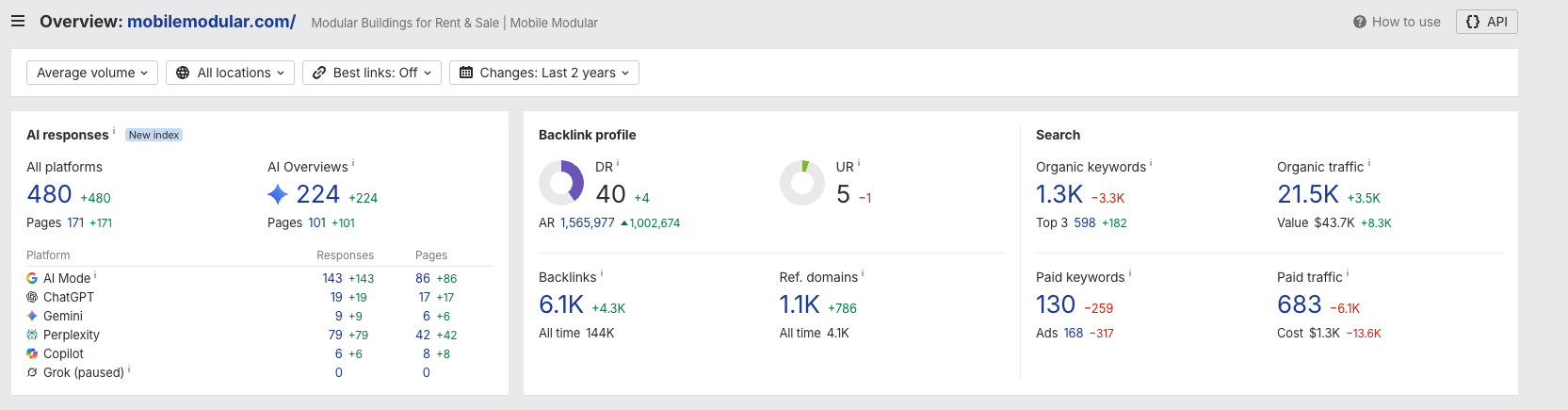
Mobile Modular
Enterprise product, use-case, and location pages are appearing in hundreds of AI answers while top-three keyword coverage and estimated organic traffic have grown.
- AI responses
- 480+480
- Pages appearing in AI responses
- 171+171
- Google AI Overviews
- 224+224
- Estimated organic traffic
- 21.5K+3.5K
Swipe or scroll to inspect the original screenshot. Tap it to open the full-size image.
Mobile Modular Portable Storage
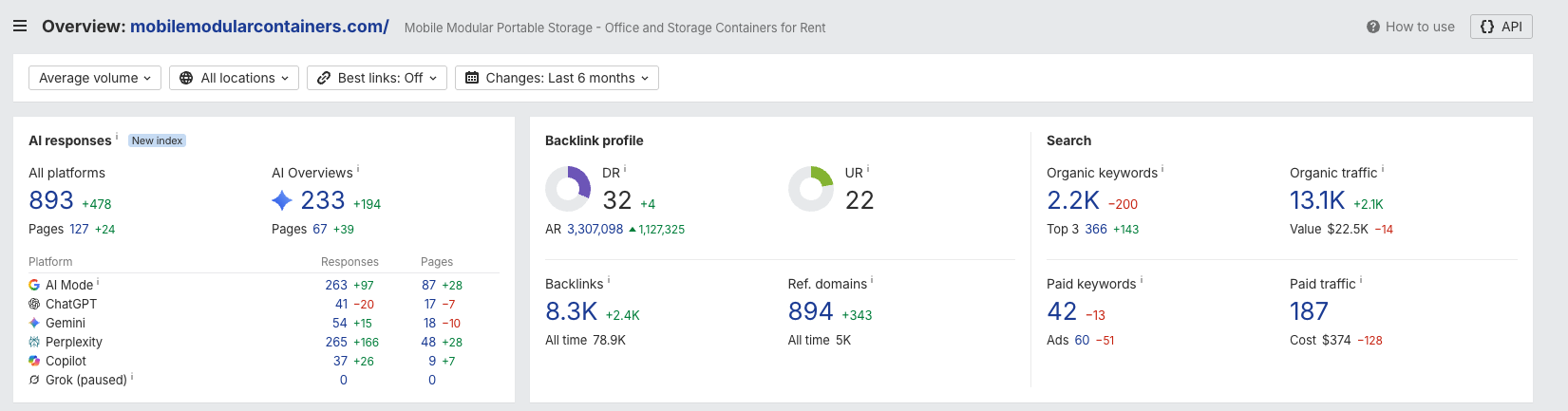
The portable-storage property is visible across five active AI platforms, with Perplexity and Google AI Mode showing the broadest page coverage in this snapshot.
- AI responses
- 893+478
- Pages appearing in AI responses
- 127+24
- Google AI Overviews
- 233+194
- Estimated organic traffic
- 13.1K+2.1K
Swipe or scroll to inspect the original screenshot. Tap it to open the full-size image.
The business, market, and work at a glance.
See whether the website, market, and responsibilities are close to the growth problem your team is trying to solve.
- Website type
- Enterprise modular-building and portable-storage website
- Markets represented
- United States
- Website and tools
- Google Search Console, Web analytics, Technical audit datasets
- What we owned
- Enterprise SEO data validation, technical audit, commercial architecture, and measurement design
What this work shows we can help your team solve.
Use these topics to judge whether our experience is close to your website, business model, and growth problem.
Industry and website
- Modular buildings and portable storage
- Enterprise modular-building and portable-storage website
- B2B SEO
SEO work
- Technical SEO
- B2B SEO
- SEO analytics
Growth problems
- Enterprise SEO data
- Technical prioritisation
A large enterprise site needed one trustworthy view of products, markets, technical issues, and search demand.
Modular-building demand varies by product, use, industry, geography, rental need, and project stage. A page can look important in isolation while duplicating another route or failing to support the locations and products that matter commercially.
The analysis combined files with different aggregation rules. Search Console page totals, query totals, device rows, analytics sessions, and business data could not be compared responsibly until each source was validated and its scope documented.
The work was designed as one connected system.
Validate the source files
Ran 34 cross-source checks covering row counts, totals, missing values, aggregation differences, and expected business splits.
Map the commercial entities
Connected products, applications, industries, service areas, rental and sales paths, and supporting resources into a clearer search architecture.
Prioritise technical findings
Separated critical crawl, indexation, template, internal-link, metadata, and page-quality constraints from lower-impact observations.
Define measurement boundaries
Kept Search Console clicks, analytics sessions, and confidential business data separate so no source was made to claim more than it measured.
What was found, what changed, and how the evidence supports it.
This table keeps the business problem, SEO response, and supporting proof together so the result can be evaluated without guesswork.
| Problem found | What changed | Supporting evidence |
|---|---|---|
| Several data exports used different aggregation levels | Validated each source independently and documented the differences | 34 checks passed and zero failed |
| Product and location demand crossed many page types | Mapped modular products, applications, industries, and service areas as connected entities | The audit covered 1,000 top page rows and 1,000 top query rows |
| Technical findings competed for attention | Classified findings by severity and implementation impact | 39 findings included seven critical items |
| Traffic could be confused with business outcome | Kept GSC, analytics, and confidential commercial records in separate evidence layers | 104,050 clicks and 154,346 sessions are reported as different measures |
The enterprise programme started from a fully validated search and analytics baseline.
The audit validated 104,050 Search Console clicks and 17,659,087 impressions across the top-page export, plus 154,346 analytics sessions. It documented 39 findings, including seven critical issues, after 34 automated validation checks passed with none failing.
Those numbers describe the scale and reliability of the baseline. They are not presented as traffic growth caused by the engagement. The commercial result of the work is a defensible priority system that connects technical changes to modular products, industries, locations, and future measurement.
What another team can take from this work.
Validate before diagnosing
Enterprise recommendations are only as trustworthy as the exports, joins, definitions, and aggregation rules underneath them.
Model how the business sells
Products, applications, industries, rental paths, and locations should shape the architecture rather than sit in separate navigation silos.
Do not turn a baseline into a success claim
Large click and session totals establish scale; later comparisons are required before they can support a growth statement.
Continue from this proof to the work it demonstrates.
Evidence is more useful when its boundary is explicit.
- The published traffic and session totals are validated baseline measures, not a before-and-after growth result.
- Confidential revenue, customer, and transaction data is not published.
- Search Console and analytics use different measurement definitions.
Have a comparable search problem?
Tell us the website, market, commercial goal, current evidence, and what your team can implement. We will recommend the right starting point.
Book a meeting